UN
UN
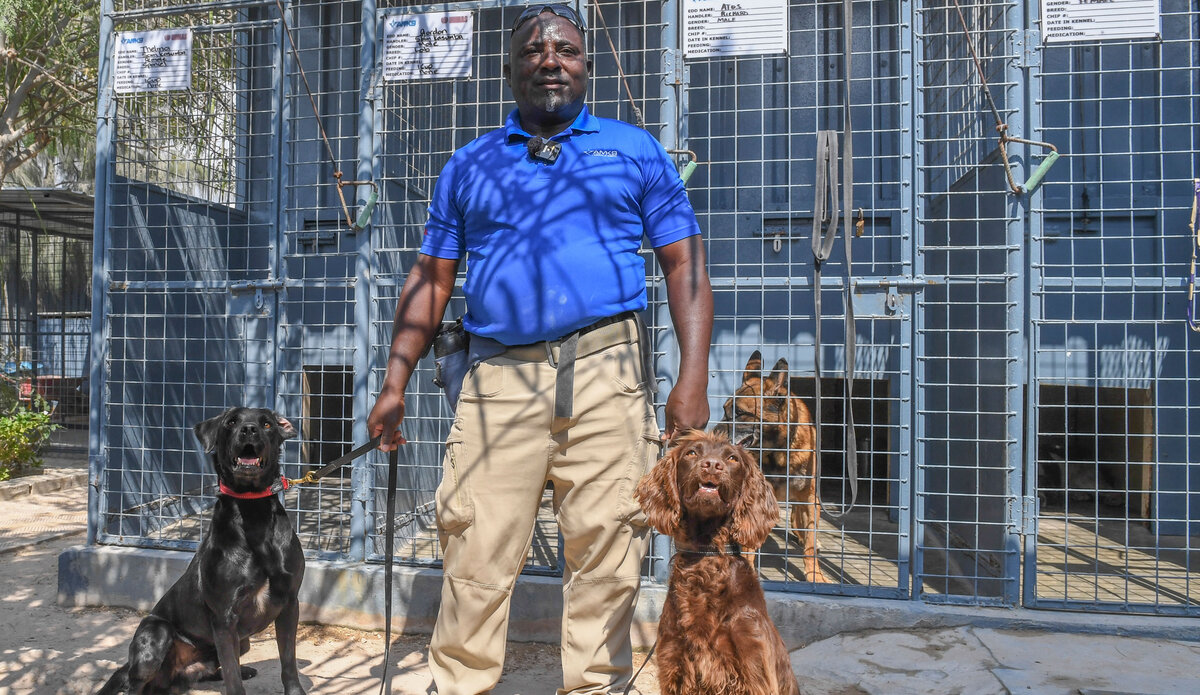
PHOTO STORY: A Day in the Life of Explosive Detection Dogs in Mogadishu
Mogadishu, 8 February 2026. As dawn breaks over Mogadishu, two four-legged professionals are already preparing for another day of service, their noses tuned to dangers invisible to the human eye. Thelma, a five-year-old female cinnamon colour Cocker Spaniel, and Gordon, a four-year-old male black colour Labrador, move alongside with their handler, Sam. Part of UNMAS’s Explosive Detection Dog (EDD) unit, they operate on the frontline of one of the world’s most complex security environments, where the threat of terrorism remains a daily reality. Quiet heroes on four paws, their work saves lives every day in Somalia.
Originally from the United Kingdom, Thelma and Gordon arrived in Somalia in 2023, with dog passports in paw. Every day, they protect people, infrastructure, and peace operations from hidden threat of explosives. In Mogadishu, their noses are frontline defences, their presence a shield, and their bond with their handler a powerful reminder that trust and teamwork can overcome even the greatest risks.
Friendly, Obedient, Trust: The Bond Behind the Mission
Behind every successful EDD is a handler who understands them instinctively. Sam has worked in Somalia since 2019 and has trained four dogs during his service. For him, being a dog handler is not just a job, it is a passion.
“My dogs are my friends,” Sam says. “We work as a team. I trust my dogs, and they trust me.”

That trust is visible in every movement. Thelma and Gordon watch Sam closely, responding and obeying to subtle hand signals and body language. This bond, built through daily work, play, and care, is essential. Without it, the dogs would not perform. With it, they excel.

Morning: Wake-Up, Health Checks, and Readiness
At 5:00 a.m., the kennel comes to life. Sam greets Thelma and Gordon as the day begins. Every day is a mission, and before any mission starts, there is a routine that never changes because in explosive detection, precision begins with care.

Each morning, Sam conducts a detailed health and medical inspection. Paws, ears, eyes, gums, and coat are carefully checked. Grooming is not only about cleanliness, but also a critical daily health assessment. Any sign of injury or fatigue is immediately reported, and a dog is withdrawn from duty if needed. Only dogs in perfect condition are cleared to work.

Once cleared, Thelma and Gordon are leashed and taken to the break area before being carefully loaded into a vehicle fitted with secure sky kennels. According to a weekly operational plan, their destination varies: training grounds or real operational duties in designated areas in Mogadishu, including checkpoints, vehicle inspections, luggage screening, buildings searches or open areas sweeps. Wherever they go, their mission is the same: detect explosives, always in a passive indication, before they can cause harm.

Training Passive Indication: Sharpening Skills That Save Lives

Under UNMAS high standards, explosive detection dogs undergo three to six months of intensive training after arriving semi-trained, usually at the age of between 18 months and two years old.

Training days simulate real operations. All dogs are trained to search vehicles, luggage, buildings, and open areas using scent detection. Before each search, Sam checks wind direction, the standard starting point and crucial factor that guides Thelma and Gordon’s highly trained noses. Detection is always passive: when explosives are detected, the dog sits. There is no scratching, no barking, no contact with the threat. When nothing is detected, there is no indication.

Rewards come as toys during training. In real operations, there is no reward, only immediate withdrawal and strict security procedures. Certified UNMAS trainers oversee these sessions, ensuring every dog and handler meets the high UN standards.

Operational Duties: Real Risks, Real Impact
At 2:00 p.m., the afternoon shift begins. Training gives way to reality. The risk is real, and the threat never fades. The gravity of the moment is clear as Sam arrives wearing a ballistic vest and helmet. This is no longer a drill. The dogs step forward with no armour of their own relying solely on their trained noses to protect everyone else.

At today’s operational site, focused on vehicle searches, cars and trucks arrive one by one. Each arrival carries uncertainty. Unlike training, there is no certainty here, no guarantees that danger is absent. An explosive could be hidden inside any vehicle. Tension is high, danger enormous. This is when Explosive Detection Dogs are not just useful, they are essential to saving lives.
Thelma and Gordon work methodically, noses low, scanning each vehicle within the secured perimeter. They inspect, smell, and assess what no machine or human eye can detect. No one, not even their handlers, knows what awaits. In these moments, experience, discipline, trust, and the unbreakable bond between dog and handler are what stand between safety and catastrophe.

These operations are intense. This is the difference between training and reality. Here, a dog sitting is not a drill: it is a warning. It may mean an explosion is imminent, lives are at risk. In this hostile environment, Thelma and Gordon are not just detectors. They are protectors. They safeguard lives of civilians, local communities, humanitarian workers, peacekeepers, and people from across the world. Their work is not a routine task, it is a frontline defence. Without them, the risk would be immeasurably higher.
Evening: Rest, Play, and Recovery
At 8 p.m., after a long shift, Thelma and Gordon return to the kennel for rest. First comes the break area, then downtime. Evenings are for bonding—playtime, socialization with other dogs, and simple companionship with Sam. Being with their handler is a reward in itself.


Dinner follows with fresh water and high-protein food. Once fed, the dogs rest. Thelma and Gordon rest unaware of the lives they have protected, the threats they have stopped, or the paths they have made safer. Tomorrow, they will do it all again.
A dedicated life of service, the Explosive Detection Dogs are a critical layer of protection in high security risk environments. These dogs prove that courage does not always speak, it sometimes sniffs, sits, and saves lives. In Mogadishu, they are not just part of the mission, they make the mission possible.